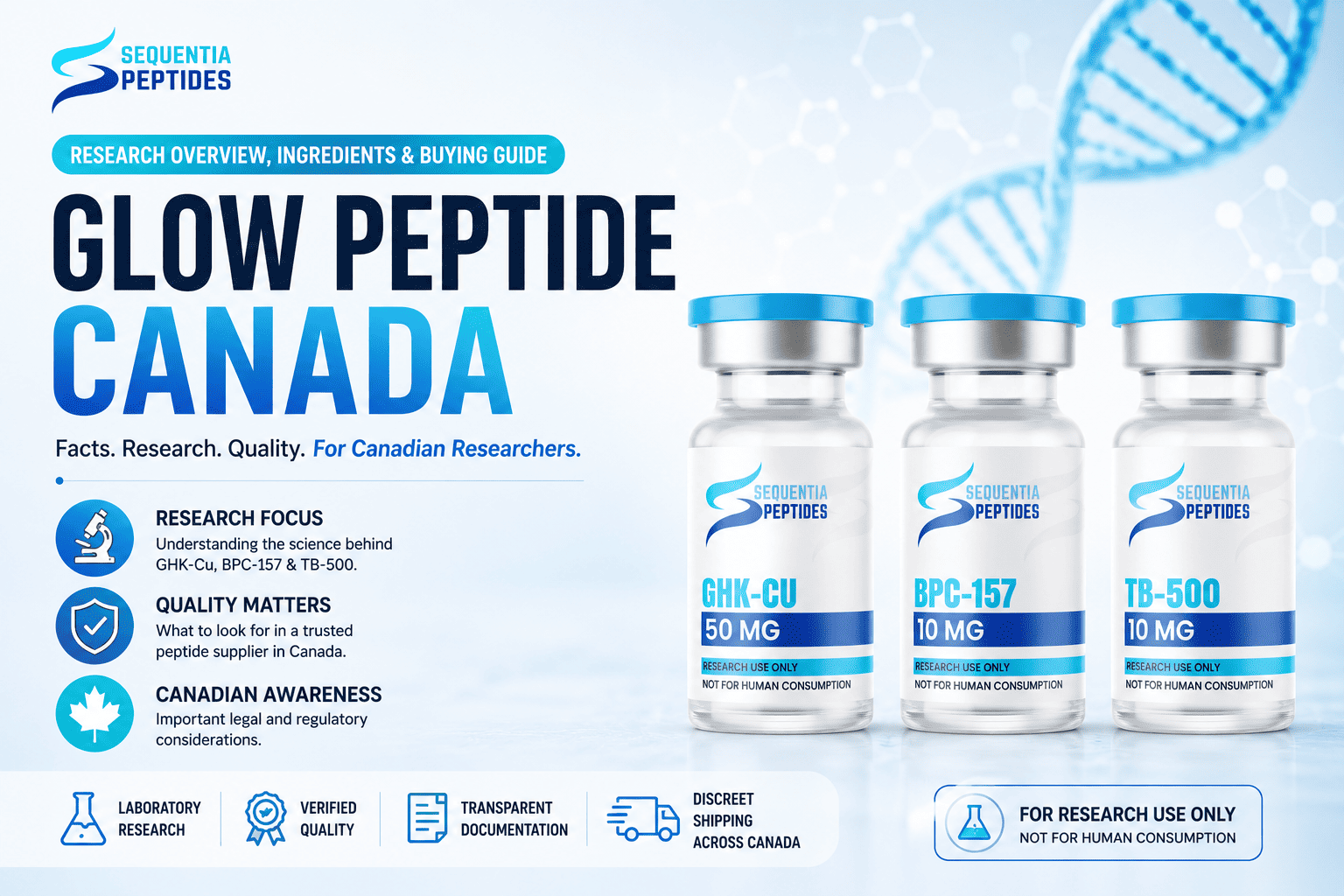
GLOW peptide is a name commonly used for a research peptide blend containing multiple peptides that are studied independently in laboratory and preclinical research.
One commonly marketed GLOW formulation combines GHK-Cu, BPC-157, and TB-500. The exact composition and ratio can vary between suppliers, so researchers should always verify the product specification rather than assuming that every GLOW product contains the same ingredients.
The concept behind a multi-peptide blend is straightforward: instead of researching individual peptides separately, researchers can investigate several compounds within a single experimental formulation.
For researchers in Canada, product identity, documentation, analytical testing, handling requirements, and applicable Canadian regulations should all be considered before acquiring any peptide product.
What Peptides Are in GLOW?
The term “GLOW peptide” does not describe one universally standardized molecule.
Different suppliers can use the GLOW name for different formulations. A commonly encountered formulation combines three research peptides:
Before purchasing, check the manufacturer’s specification for the exact ingredients, quantity, formulation, and analytical documentation.
GHK-Cu
GHK-Cu is a copper-containing peptide that has been studied in several areas of biological and cellular research.
Researchers have investigated GHK-Cu in connection with processes involving extracellular matrix biology, cellular signaling, and gene-expression pathways.
It is important to distinguish laboratory research from established medical applications. Findings from cell or animal studies do not automatically demonstrate that a compound is safe or effective for a particular use in humans.
For research purposes, investigators may therefore examine GHK-Cu as an individual experimental variable or as part of a multi-component research formulation.
BPC-157
BPC-157 is a synthetic peptide that has been investigated primarily in preclinical research.
Studies have examined BPC-157 in different experimental models, including research involving cellular and tissue-related processes.
However, preclinical findings should not be interpreted as proof of a treatment effect in humans.
Researchers evaluating BPC-157 should distinguish carefully between laboratory findings, animal research, human clinical evidence, and marketing claims.
TB-500
TB-500 is a name commonly associated with a synthetic peptide related to thymosin beta-4 research.
Research involving thymosin-related peptides has examined a variety of biological processes in experimental settings.
As with other research peptides, the existence of laboratory or preclinical studies does not establish that a commercially available research product is approved for human use.
Researchers should evaluate the exact material being purchased rather than relying only on the product name.
Why Are GHK-Cu, BPC-157, and TB-500 Combined?
The three components are often grouped together because they have been investigated across overlapping areas of biological research.
However, combining several peptides does not automatically mean that the combination has been clinically demonstrated to be superior to the individual components.
A research blend should therefore be viewed as an experimental formulation, not as a proven therapeutic combination.
For laboratory researchers, a multi-component formulation can provide a convenient way to investigate interactions or comparative experimental questions.
The exact research question, experimental model, and controls should determine whether a blend is appropriate for a particular study.
GLOW Peptide Research: What Does the Science Actually Show?
One of the biggest problems with peptide information online is the difference between research findings and marketing claims.
A laboratory study may demonstrate that a compound produces an observable effect under specific experimental conditions. That does not necessarily establish clinical effectiveness, appropriate human dosage, long-term safety, suitability for self-administration, regulatory approval, or effectiveness for treating a medical condition.
Researchers should evaluate the evidence behind individual claims rather than relying on broad statements such as “heals,” “rejuvenates,” “repairs,” or “reverses aging.”
When reviewing GLOW peptide information, ask:
What peptide was actually studied?
Was the research performed in cells, animals, or humans?
What formulation was used?
What concentration was tested?
Was the result independently reproduced?
Does the available research actually support the claim being made?
This approach helps separate scientific evidence from promotional language.
GLOW Peptide vs. Individual Peptides
A GLOW blend and an individual peptide are not necessarily interchangeable research materials.
GHK-Cu is an individual peptide, BPC-157 is an individual peptide, and TB-500 is an individual peptide-related research material. GLOW is generally used as a name for a multi-peptide research formulation.
An individual peptide may be preferable when a researcher wants to isolate one variable. A multi-peptide formulation may be relevant when the research question specifically involves multiple compounds.
The correct choice depends on the experimental design.
What Should Researchers Look for When Buying GLOW Peptide in Canada?
If you are evaluating a research peptide supplier, the product name alone should not be the deciding factor.
Consider the following factors before making a decision.
1. Clear Product Identification
The product should clearly identify:
Product name
Ingredients
Quantity
Batch or lot information, where applicable
Storage information
Intended research use
Avoid products with vague or incomplete labeling.
2. Analytical Documentation
Researchers should look for appropriate analytical documentation supporting the identity and stated characteristics of the material.
Depending on the product, documentation may include analytical testing such as:
HPLC
Mass spectrometry
Purity analysis
Other relevant laboratory testing
A certificate or report should be associated with the appropriate product or batch rather than being a generic document unrelated to the material being purchased.
3. Transparent Product Information
A reputable research supplier should provide enough information for researchers to understand what they are purchasing.
Look for:
Ingredient disclosure
Product specifications
Storage requirements
Lot information
Research-use restrictions
Contact information
Relevant documentation
4. Clear Research-Use Positioning
A legitimate research product should not be marketed as a treatment for diseases or as a substitute for approved medical care.
Be cautious of websites that make dramatic promises about curing diseases, reversing aging, guaranteed tissue repair, weight loss, bodybuilding results, or other guaranteed human outcomes.
Is GLOW Peptide Legal in Canada?
This is an important question, and the answer depends on the specific product, intended use, formulation, regulatory status, and how the product is marketed or supplied.
Health Canada has warned Canadians about unauthorized injectable peptide drugs sold online, including products containing or marketed as BPC-157, GHK-Cu, and TB-500. Health Canada states that unauthorized injectable peptide drugs have not been assessed for safety, efficacy, and quality.
Health Canada has also taken enforcement action against companies involved in the unauthorized sale and advertising of injectable peptides in Canada.
For that reason, researchers should not assume that a product is legally saleable or importable simply because a website describes it as “research use only.”
Always verify the current Canadian regulatory requirements applicable to the specific product and intended research activity.
Is GLOW Peptide Approved for Human Use?
A research peptide should not be presented as an approved human medication unless it actually has the appropriate regulatory authorization.
Health Canada states that authorized prescription drugs in Canada have an eight-digit Drug Identification Number (DIN) and advises consumers to verify authorization through the appropriate Health Canada databases.
Therefore, a research product should not be represented as:
A prescription treatment
An approved medication
A dietary supplement
A clinically proven therapy
unless the relevant regulatory authorization supports that statement.
How to Evaluate a GLOW Peptide Supplier
Before choosing a supplier, compare more than price.
Product Information
Ask:
Is the composition clearly stated?
Is the quantity clearly specified?
Is the intended research use clearly communicated?
Quality Documentation
Check:
Is analytical documentation available?
Is the documentation associated with the relevant product or batch?
Are testing methods identified?
Business Transparency
Look for:
Clear company contact information
Shipping and return policies
Clearly stated terms and conditions
Regulatory Awareness
Consider whether the supplier:
Avoids unsupported medical claims
Clearly distinguishes research products from approved medicines
Communicates applicable restrictions
A lower price does not necessarily mean better value if the product lacks adequate documentation or traceability.
GLOW Peptide Canada: Frequently Asked Questions
What is GLOW peptide?
GLOW peptide is a name commonly used for a multi-peptide research formulation. One commonly marketed formulation contains GHK-Cu, BPC-157, and TB-500. The exact composition can vary, so researchers should verify the specification of the individual product.
What is in GLOW peptide?
A commonly encountered GLOW formulation contains GHK-Cu, BPC-157, and TB-500. Always check the manufacturer’s current product specification for the exact composition.
Is GLOW peptide approved for human use?
Research-use peptide products should not be represented as approved human medications unless they have the appropriate regulatory authorization. Researchers should verify the regulatory status of the specific product in Canada.
Is GLOW peptide the same as GHK-Cu?
No. GHK-Cu is an individual peptide. GLOW is generally used as a name for a multi-peptide formulation that may contain GHK-Cu together with other peptides.
Is GLOW peptide the same as BPC-157?
No. BPC-157 is one individual peptide that may be included in some GLOW formulations.
Is GLOW peptide the same as TB-500?
No. TB-500 is an individual peptide-related research material that may be included in some GLOW formulations.
What should I check before purchasing GLOW peptide in Canada?
Check the exact composition, product specifications, analytical documentation, batch or lot information where available, storage requirements, and research-use restrictions. You should also verify applicable Canadian regulatory requirements.
Does every GLOW peptide product have the same formulation?
No. The name “GLOW” is not sufficient to establish an identical formulation across suppliers. Always check the specific product documentation.
Can GLOW peptide be used as a treatment?
Research materials should not be presented as treatments for medical conditions. Human use of unauthorized injectable peptide drugs can pose serious risks, and Health Canada advises Canadians not to buy or use unauthorized injectable peptide products.
Final Thoughts
GLOW peptide has become a commonly discussed name in the research peptide market, particularly for formulations combining GHK-Cu, BPC-157, and TB-500.
However, researchers should look beyond the product name.
The most useful questions are:
What exactly is in the product?
What evidence supports the individual research compounds?
What analytical documentation is available?
Is the product appropriately labeled and documented for its intended research purpose?
What Canadian regulatory requirements apply?
Taking this evidence-first approach helps researchers make more informed decisions while avoiding the unsupported medical claims that are common in the online peptide market.
For Canadian researchers evaluating research peptide materials, product transparency, documentation, and regulatory awareness should be more important than marketing promises or price alone.
Research Disclaimer
The information provided in this article is for general educational and research-information purposes only. It is not medical advice and does not constitute a recommendation to use any peptide product in humans or animals.
Research peptides discussed on this page are not presented as treatments, cures, or preventive medicines. Do not use research products for self-administration.
Canadian laws and regulatory requirements can change. Researchers should verify current requirements with the appropriate Canadian authorities before purchasing, importing, handling, or using any research material.
Health Canada advises Canadians not to buy or use unauthorized injectable peptide drugs and recommends consulting a healthcare professional regarding health concerns related to such products.
DISCLAIMER
All products sold by Sequentia Peptides are strictly intended for laboratory and scientific research purposes only. They are not approved by Health Canada for human or animal use, consumption, or any therapeutic application. By entering this site, you confirm that you:
Are of legal age of majority in your province or territory (18 or 19 years of age)
Are a qualified research professional purchasing solely for legitimate research purposes
Acknowledge that Sequentia Peptides does not provide dosing guidance, administration advice, or reconstitution instructions of any kind
Understand that Sequentia Peptides is not a pharmacy or compounding facility and does not operate as one
Confirm that you have read and agree to our Terms & Conditions in full
Sequentia Peptides operates in full compliance with all applicable provincial and federal Canadian laws governing the sale of research chemicals.