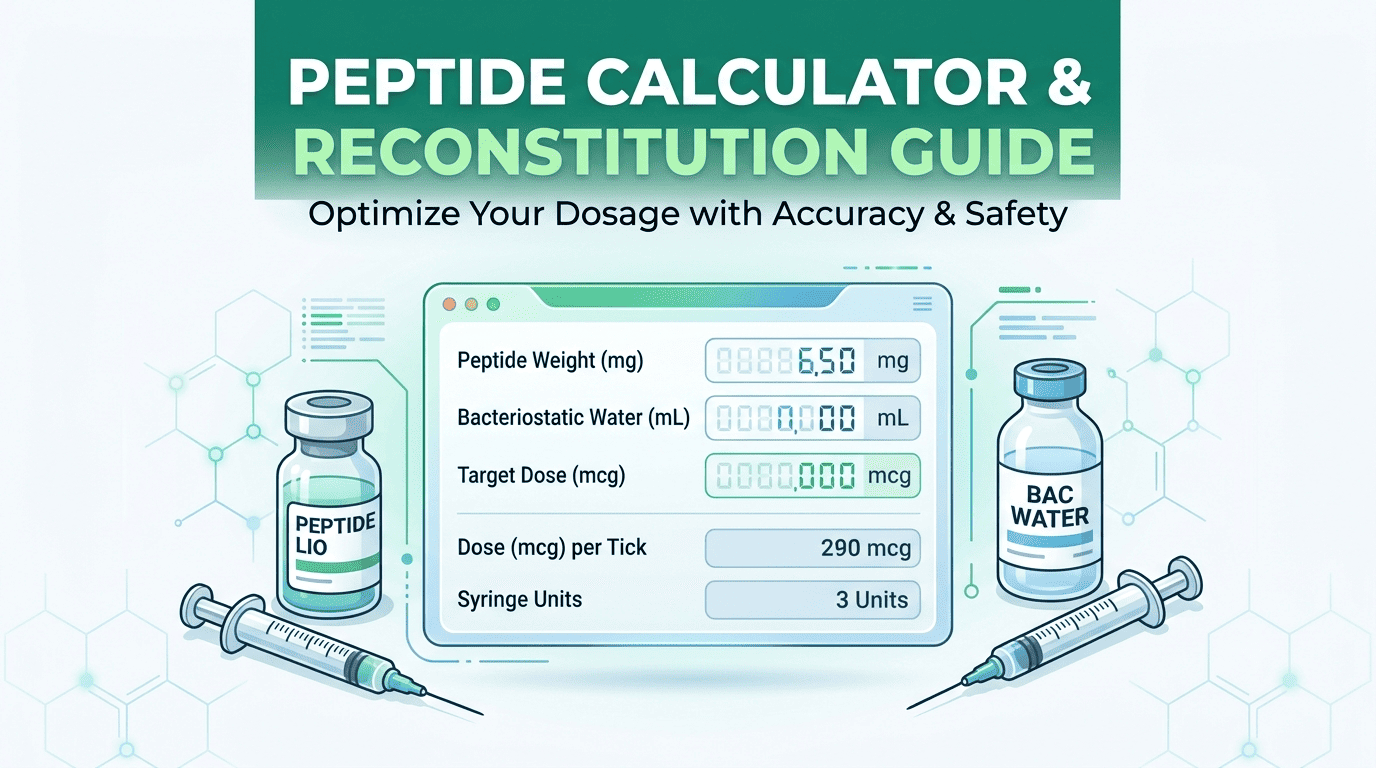
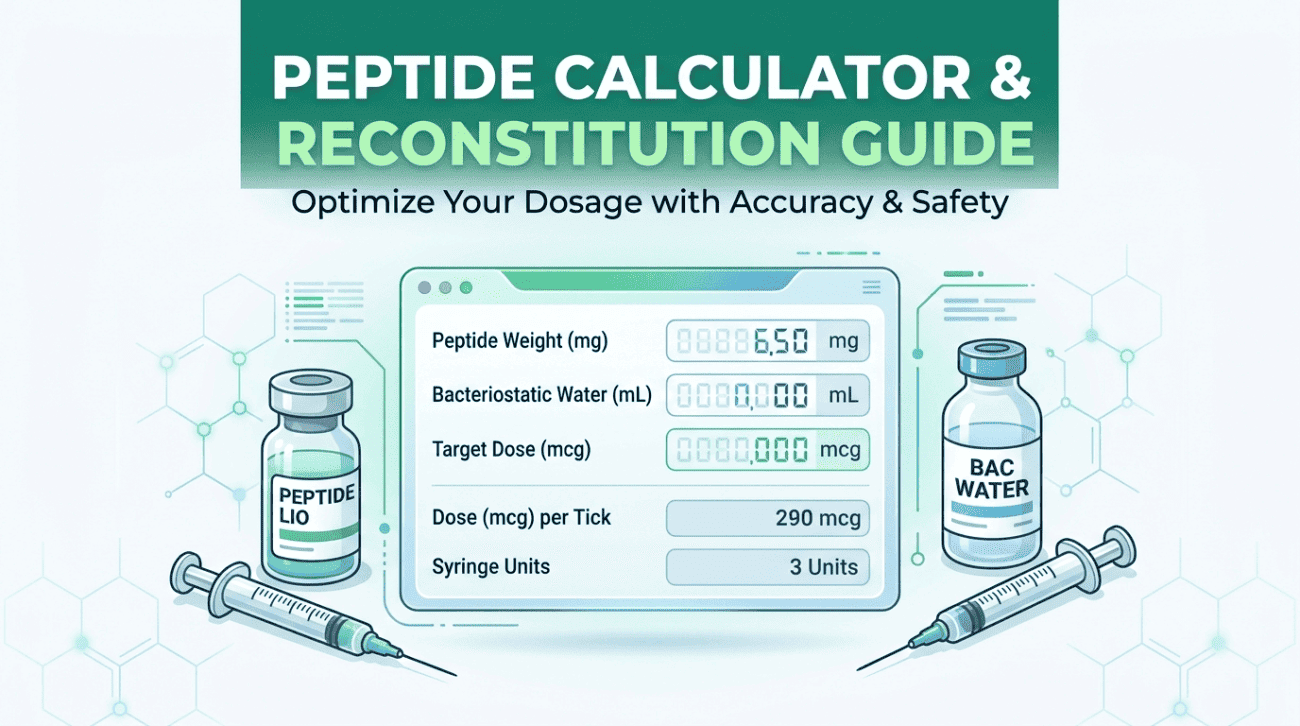
Understanding Peptide Calculators: A Comprehensive Guide
Whether you are researching therapeutic compounds for fitness, wellness, or anti-aging, precision is paramount. A peptide calculator is an essential tool that takes the guesswork out of your routine. This comprehensive guide will walk you through the math, the preparation, and the tools you need to ensure accurate, safe dosing every single time.
A Quick Reconstituting Lyophilized Peptides Guide
Before calculating your dose, you must properly prepare your vial. Following the best practices for peptide lyophilized powder ensures your compound remains viable and effective. One of the first decisions you will make is choosing between bacteriostatic water vs sterile water for peptides. Bacteriostatic water is highly recommended because it contains a small amount of benzyl alcohol, which prevents bacterial growth and extends the mixture’s usability.
A common question for beginners is how much bacteriostatic water to add. The volume of water you choose dictates your final liquid concentration. For instance, determining the ideal reconstitution volume for 5mg vial often comes down to personal preference, though adding 1mL or 2mL are standard choices. Keeping a peptide vial concentration chart on hand can provide a quick visual reference for your mixture’s overall strength.
Following Health Canada safety guidelines for sterile reconstitution helps prevent contamination and ensures compound stability
Mastering the Math: Calculators vs. Formulas
When it comes to calculating precise peptide dosage, researchers generally have two options:
Manual Math: You can use manual dosage calculation methods that rely on the standard peptide reconstitution math formula: (Total mcg of peptide 7 Total mL of water) = mcg per mL.
Digital Tools: To eliminate human error, many prefer using a dedicated peptide calculator app or popular web platforms like the jay campbell peptide calculator. A reliable peptide dosage calculator instantly processes your vial size and water volume to give you the exact draw amount.
For a quick validation example: a 5mg vial contains 5,000mcg. If you add 2mL of bacteriostatic water, the concentration becomes 2,500mcg per mL. On a U-100 insulin syringe, 1mL equals 100 units, so each unit corresponds to 25mcg. If your target is 250mcg, you would draw 10 units. Many calculators present this as “units to draw,” but it is still prudent to back-check the arithmetic whenever you change vial size, reconstitution volume, or target dose.
Syringes, Units, and Precise Measurements
Knowing exactly how to measure peptides in a syringe is just as crucial as the underlying math. Because most protocols utilize standard insulin syringes, understanding u-100 syringe markings is a foundational skill.
Remember, the tick marks on the barrel represent “units,” not micrograms (mcg) or milligrams (mg). This means you must perform an accurate insulin syringe units to mcg conversion before drawing your liquid. While keeping a printed mcg to units conversion table nearby is a great way to double-check your work, using a digital calculator remains the safest way to ensure the unit markings perfectly align with your desired dose.
Common Pitfalls and Quality-Control Checks
Most dosing errors are procedural rather than mathematical. The most frequent issues include misreading “mg” for “mcg,” assuming all insulin syringes share identical graduations, and forgetting that changing the diluent volume changes every downstream conversion. Label the vial with the date, total peptide amount, and reconstitution volume, then record the resulting concentration (mcg per mL) in a log. If your calculator supports it, enter values in the same units shown on your vial label to avoid silent unit conversion mistakes. Finally, treat calculator outputs as research aids rather than clinical directives; individual protocols, contraindications, and product variability require qualified medical oversight.
Storage and Longevity
Once your vial is mixed, safe handling is vital. Storing reconstituted peptides safely typically in a refrigerator away from direct light and extreme temperature changes7 protects the delicate molecular bonds from degrading. Furthermore, determining peptide shelf life after mixing depends largely on your chosen diluent. Mixtures prepared with bacteriostatic water generally remain stable and effective for 3 to 4 weeks when properly refrigerated.
The Takeaway
Whether you prefer crunching the numbers yourself or relying on a smart app, accuracy is non-negotiable. By understanding your vial’s concentration, mastering syringe conversions, and leveraging modern calculators, you can approach your peptide research with total confidence and safety
All products sold by Sequentia Peptides are strictly intended for laboratory and scientific research purposes only. They are not approved by Health Canada for human or animal use, consumption, or any therapeutic application. By entering this site, you confirm that you:
Are of legal age of majority in your province or territory (18 or 19 years of age)
Are a qualified research professional purchasing solely for legitimate research purposes
Acknowledge that Sequentia Peptides does not provide dosing guidance, administration advice, or reconstitution instructions of any kind
Understand that Sequentia Peptides is not a pharmacy or compounding facility and does not operate as one
Confirm that you have read and agree to our Terms & Conditions in full
Sequentia Peptides operates in full compliance with all applicable provincial and federal Canadian laws governing the sale of research chemicals.